Website Analysis
What the Best Concrete Contractor Websites Do Right
There's a consistent pattern among concrete contractor websites that generate steady inbound leads. It's not about design trends or expensive features — it's about structure, speed, and conversion architecture. This guide breaks down exactly what the best concrete websites do differently.
The Pattern
What Separates a Generating Website From a Presence Website
In the contractor space, there are two types of websites. The first type is built to exist online — it has a homepage, a services page, a contact form, and some photos. It checks the "we have a website" box. The second type is built to generate business. It ranks on Google, converts visitors into quote requests, and grows its lead volume over time.
After reviewing hundreds of concrete contractor websites across Chicagoland and beyond, the distinction comes down to six characteristics that consistently separate the generators from the placeholders. None of them require expensive design work or complex technology. All of them require deliberate, specific execution.
These aren't design opinions or aesthetic preferences — they're conversion and SEO realities. A site that executes all six will outperform a visually stunning site that misses two or three of them, every time. Here's what they are, and how to evaluate whether your current site has them.
MP Digital builds these traits into every concrete contractor website we produce. You can see the results in our Chicagoland Masonry case study and portfolio.
The Six Traits
What the Best Concrete Contractor Websites Share
Loads in Under 3 Seconds on Mobile
The majority of homeowners searching for concrete contractors are on their phones, often outdoors or between tasks. A site that takes 5 seconds to load loses most of those visitors before they see a single word of content. The best concrete contractor websites are engineered for mobile speed first — compressed images, clean code, minimal render-blocking scripts.
A well-built concrete site should score 85+ on Google PageSpeed for mobile. Most template-based contractor sites score 30–50.
Project Gallery Organized by Service
Concrete work is sold visually before it's sold verbally. A homeowner considering a driveway replacement wants to see driveways — not a general "projects" page mixing patios, foundations, and sidewalks. The best concrete sites organize their gallery by service type so every visitor sees exactly what they're considering hiring for.
Separate gallery sections for driveways, patios, decorative, foundations, and commercial work — each with before-and-after pairs where possible.
Dedicated SEO Page for Every Service
A "Services" page listing everything you do ranks for nothing specifically. The best concrete contractor websites have individual pages for driveways, patios, foundations, sidewalks, decorative concrete, and commercial flatwork — each structured to rank for its own set of local keywords and convert visitors with service-specific content and CTAs.
/concrete-driveway-contractor-naperville, /concrete-patio-installer-oak-brook, /foundation-contractor-chicago — each with 500+ words of focused content.
Phone Number and Quote Form Above the Fold
Conversion architecture starts at the top of the page. A visitor should never have to scroll to find out how to contact you. The best concrete contractor websites have a visible phone number and a simple quote request form (or click-to-call button) visible on every page without scrolling — especially on mobile.
Sticky header with phone number on desktop. Fixed click-to-call button on mobile. Quote form on every service page, not just the contact page.
Reviews Displayed Throughout the Site
Homeowners hiring a concrete contractor are making a significant financial decision. Social proof — Google reviews, star ratings, testimonials from real customers — is the primary conversion factor for undecided visitors. The best concrete websites display reviews on the homepage, service pages, and above the quote form where conversion intent is highest.
Embedded Google review widget or static testimonials with customer name, city, and project type. A star rating callout (e.g., "4.9 stars across 47 Google reviews") in the hero section.
Clear Value Proposition in the First 5 Seconds
A visitor landing on your homepage should immediately know: who you are, what you do, where you serve, and why you're worth calling. "Quality Concrete Work You Can Count On" communicates nothing. The best concrete contractor websites lead with a specific, localized headline: "Chicagoland's Concrete Contractor for Driveways, Patios & Foundations — Free Estimates."
Hero headline includes location, primary services, and a differentiator. Supported by 3–5 credibility badges: years in business, service area, licensing, free estimates.
What to Avoid
The 8 Most Common Concrete Contractor Website Mistakes
Single "Services" page for all offerings
Ranks for nothing specifically. Visitors can't evaluate services quickly. No dedicated conversion paths.
No project photo gallery — or one unsorted gallery
Fails to establish visual credibility. Visitors can't match their project type to your work.
Phone number only in the footer
Mobile visitors who don't scroll miss the only contact option. Significant conversion loss.
Generic hero: "Quality Concrete at Affordable Prices"
Communicates nothing about location, services, or differentiation. Doesn't pass the 5-second test.
No reviews on the site
Missing the primary trust signal that converts fence-sitters into callers. Especially damaging for high-value jobs.
No location-specific content
Invisible in city/suburb searches beyond the home address. Leaves entire geographic markets uncaptured.
Slow mobile load time (5+ seconds)
Google penalizes slow sites in rankings. Users abandon before seeing any content.
No schema markup
Missing rich results (star ratings, FAQ dropdowns) in search. Reduced click-through rates from SERP.
Start My Website to tell us about your business, and we will recommend the right place to begin — including a review of these eight mistakes if your current site needs work. Pair website improvements with contractor SEO and Google Business Profile optimization for the strongest possible local search position.
Self-Assessment
How to Evaluate Your Own Concrete Website
Mobile Load Speed
Run URL through Google PageSpeed Insights. Target: 85+ mobile score.
Service Page Architecture
Count dedicated pages for each concrete service. Target: 1 page per major service minimum.
Location Coverage
Check for location-specific pages or suburb mentions. Target: page for each city in service area.
Above-Fold CTA
View homepage on mobile without scrolling. Is the phone number visible? Is there a quote CTA?
Project Gallery
Look for organized photo galleries by service type with before-after pairs.
Review Display
Check homepage and service pages for embedded reviews or testimonials.
Schema Markup
Run through Google Rich Results Test. Look for LocalBusiness and Service schema.
H1 Tag Structure
Use browser inspector or SEO tool. Every page should have exactly one H1 including a service + location keyword.
Score 6 or fewer out of 8? Your site has structural issues that are costing you inbound leads. Our free website audit will identify each gap and quantify what it's costing you.
Real Examples
Concrete Contractor Websites We've Built
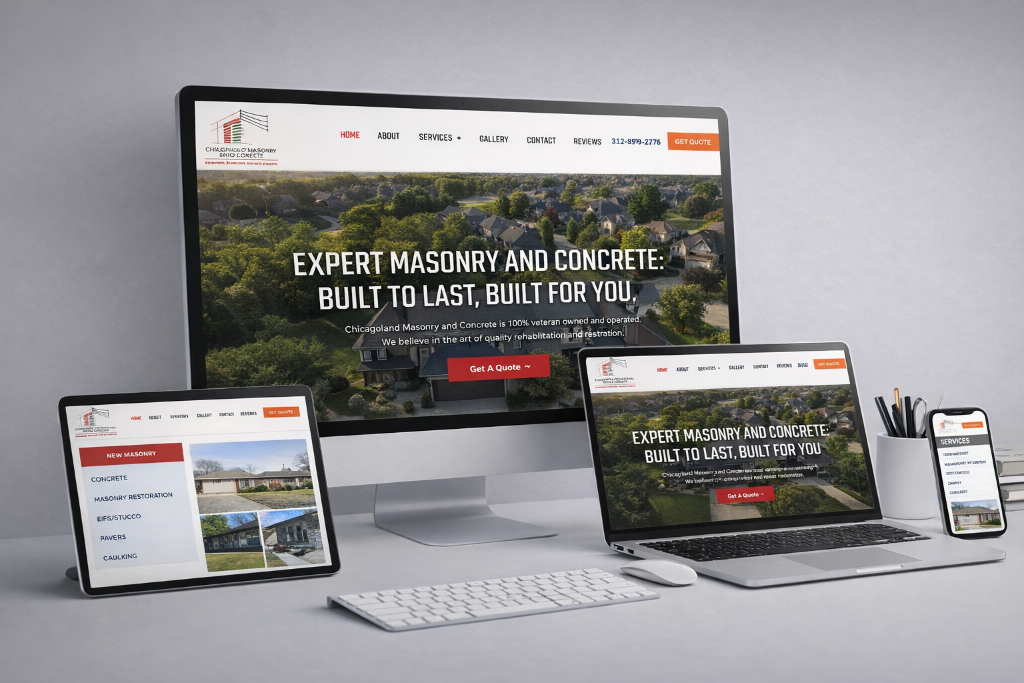
Oak Brook, IL
Chicagoland Masonry & Concrete
Gallery-forward design, service-specific pages for masonry and concrete, location coverage across the western suburbs, and strong local SEO structure from day one.
View Case Study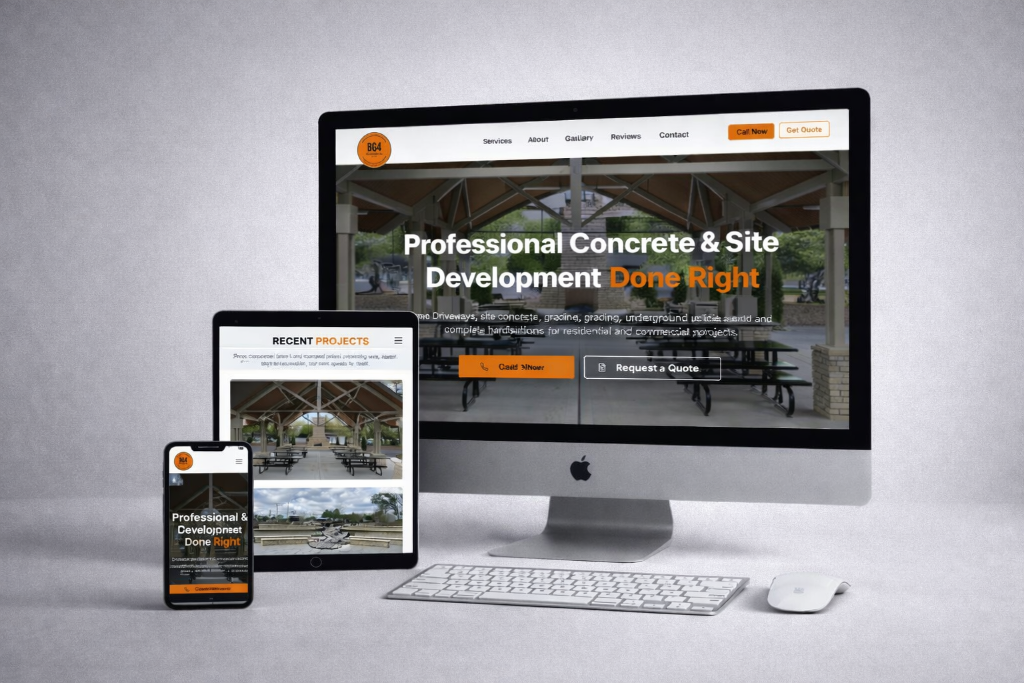
DeKalb County, IL
BG4 Construction
Mobile-first build with immediate above-fold CTA, organized service pages for concrete and site development work, and a streamlined quote request path.
View Case StudyCommon Questions
Concrete Website Design FAQ
Build the Right One
Get a Concrete Website That Actually Generates Leads
We'll audit your current site against all six traits, identify every gap, and build a concrete contractor website that ranks, converts, and compounds in value over time.